About
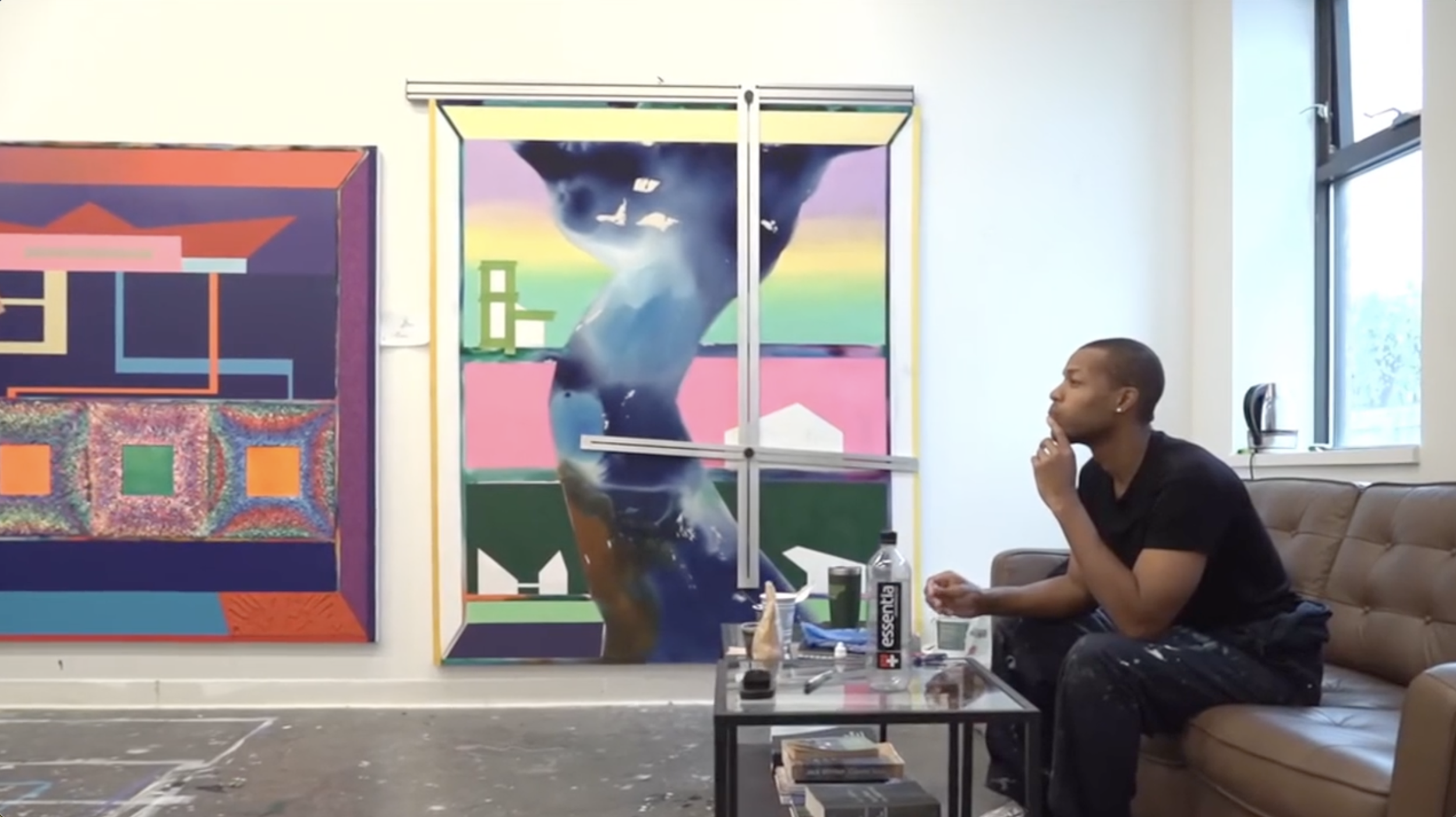
Bio
Jamaal Peterman (b. 1990, Fort Lauderdale, FL; lives and works in New York, received his MFA at Pratt Institute (2019) and BFA from the University of Maryland Eastern Shore (2014). He has been included in exhibitions at the Museum of Contemporary African Diasporan Art (MoCADA), Columbus Museum of Art, Phoenix Art Museum Baltimore Museum of Art, Public ArtFund, Brooklyn Museum; the University of Chicago; University of Louisville, Kavi Gupta, Chicago; James Fuentes, New York and Vigo Gallery, London.
Artist Statement
I build paintings as navigable systems grids, blocks, and thresholds where color, line, and surface encode how Black and brown bodies move through, and are shaped by, the city. My language of geometric abstraction maps routes of access and exclusion: shades of black and brown stand in for people, businesses, and ecosystems; lines connect and sever like streets, circuit traces, and redlining diagrams. Textured passages sand, scored marks, pressed symbols function as “cheat codes” for entering the image, like a handprint in wet cement: a tactile record that persists even as bodies are moved or erased.
The work examines how hierarchies of space and movement mirror hierarchies of class and race. I treat the canvas as a plan you read with the body as much as the eye: edges behave like curbs and corridors; pace is set by rhythm, interruption, and return. Lines of connection carry multiple registers at once urban circulation, data flow, family lineage and their quantity and direction suggest who is allowed to pass, who is delayed, and who is turned away. In this sense, the paintings are not illustrations of policy but translations of lived navigation.
Over time, the code has shifted from a macro view of systemic pressure to lived geography and memory. Compositions draw from aerial schematics, neighborhood cartographies, and the routes I have driven and walked where infrastructure both enables movement and scripts constraint. Surfaces resembling sidewalks, bricks, or façades hold expressionistic marks that act as notations of presence and loss; they register everyday touch and the disappearance of physical identitywithin the built environment. Color operates structurally as well as symbolically: fields of black and brown designate bodies and the ecologies that hold them, while sharp contrasts mark points of friction, passage, and refusal.
Research enters the studio as mapping and fragment redlining diagrams, civic plans, and local histories but the paintings insist on the human scale of the hand. I am interested in how abstraction can hold biography without depicting it directly: how a measured grid, a scored line, or a weighted field can carry memory, pressure, and care. Each work asks how form can orient the viewer how to read a path, how to locate oneself, how to imagine return.
Ultimately, I want the paintings to function as tools for orientation to make visible the structures that organize movement while honoring the communities that persist within them. By giving structure to movement and time, the work aims toward navigation, memory, and repair: a practice of seeing that accounts for what has been built, what has been buried, and what remains in motion.
Quisque iaculis facilisis lacinia. Mauris euismod pellentesque tellus sit amet mollis.